Skip to Content
Electroless Nickel Plating

Uniform, High-Performance Electroless Nickel Plating.

Nickel-phosphorus coatings for complex geometries, internal features, and parts where even thickness and predictable performance matter — from prototype to production.

Best for
Complex Geometry Internal Features Tight Tolerances Corrosion Resistance

Autocatalytic, current-free deposition — the chemistry, not the geometry, drives uniform coverage on edges, recesses, and internal features that conventional plating struggles with.

A coating formed by chemistry, not by current.

Electroless nickel plating is an autocatalytic process. Because the coating forms chemically rather than driven by current density, it delivers consistent thickness across surfaces that electroplating cannot reliably reach.

01

What Is Electroless Nickel Plating?

Electroless nickel plating is an autocatalytic process that deposits a nickel-phosphorus alloy without external electrical current. Because the coating is formed chemically rather than driven by current density, it delivers highly uniform coverage across external surfaces, recesses, edges, and many internal features.

02

When to Use Electroless Nickel

Choose electroless nickel when your application requires consistent thickness on complex geometry, corrosion resistance in demanding environments, dependable coverage inside holes or channels, or a finish that supports tight dimensional control. It is especially valuable when part geometry makes conventional electroplating less predictable.

Five reasons buyers specify electroless.

The combination of uniform deposition, corrosion performance, and dimensional consistency is what makes electroless nickel the default specification for engineering-driven parts.

01

Uniform Thickness

Consistent coverage across complex surfaces, edges, recesses, and internal features.

02

Corrosion Resistance

Strong, reliable performance in harsh service environments and aggressive media.

03

Improved Wear Life

Higher service hours under load, friction, and abrasive operating conditions.

04

Smooth, Low Porosity

Surface finish supports lubricity and easier movement in mating assemblies.

05

Repeatable Results

Predictable outcomes on parts where geometry would otherwise create variation.

Choose the right phosphorus content for your application.

High, medium, and low phosphorus electroless nickel each behave differently. The right chemistry depends on the operating environment, downstream processing, and the controlling specification.

Maximum Corrosion
High Phosphorus

Selected when maximum corrosion resistance is the primary goal — chemical exposure, aggressive service environments, marine and energy applications.

Versatile
Medium Phosphorus

Used when the application needs a balanced combination of corrosion resistance, wear performance, and overall versatility — the common workhorse specification.

Hardness · Wear
Low Phosphorus

Considered when hardness, wear resistance, and solderability are the key concerns — tooling, mating surfaces, and electronics assembly applications.

Not sure which phosphorus level fits? Send us the application details and the controlling specification — we'll match the chemistry to the part. Help Me Choose →

Electroless nickel-plated parts Production Floor

Used on the substrates that matter, on the parts that matter most.

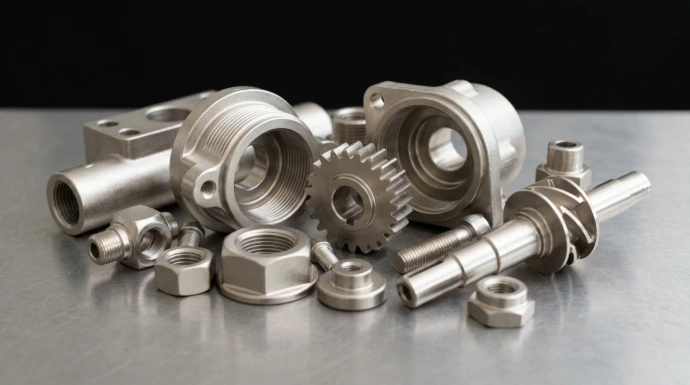
Electroless nickel is widely used on steel, stainless steel, aluminum, copper, brass, and other engineered substrates where the correct preparation sequence is applied.

Typical applications include aerospace components, automotive parts, medical components, industrial tooling, valves, fittings, housings, and parts with internal passages or complex contours.

Advanced Masking & Flow Plating

Entech supports advanced masking and flow plating methods that help localize or control coating where the application requires it. This is especially valuable when specific areas must remain untreated, when a component includes critical sealing or mating surfaces, or when a more targeted process approach is needed.

Process discipline, before the part enters the tank.

We combine specification discipline, process control, masking capability, and experience with complex parts to deliver electroless nickel coatings that are uniform, functional, and reliable.

01

Drawing Review

Each job is reviewed against drawing requirements, material condition, thickness targets, and inspection expectations before processing.

02

Specification Match

Right phosphorus content, right thickness, right preparation — selected against the controlling spec, not the bath we already had running.

03

Documentation

Inspection-ready records, certificates of conformance, and traceability that match what regulated buyers need.

04

Hard Parts Welcome

Internal features. Mixed substrates. Tight tolerances. Selective masking. We engineer the process around your part — not the other way around.

From enquiry to delivery.

Each step exists to remove a variable. By the time your parts hit the bath, every decision is already made on paper.

📋
1
Drawing & Spec Review

Material, thickness, masking, finish callout, and applicable standard reviewed before quoting.

🧪
2
Cleaning & Activation

Substrate-matched preparation sequence to support reliable adhesion and consistent deposit.

⚗️
3
Bath Plating

Phosphorus chemistry, temperature, and pH controlled to drive the deposit specified for your part.

📦
4
Inspect & Ship

Thickness verification, visual inspection, certificates of conformance, and secure packaging.

Need uniform nickel coverage on a complex part?

Send us your part drawing, material, performance requirement, and specification so we can review the right electroless nickel solution.